The Timing Is Now: Why Youth Mental Health is the Next Economic Imperative
February 13, 2026
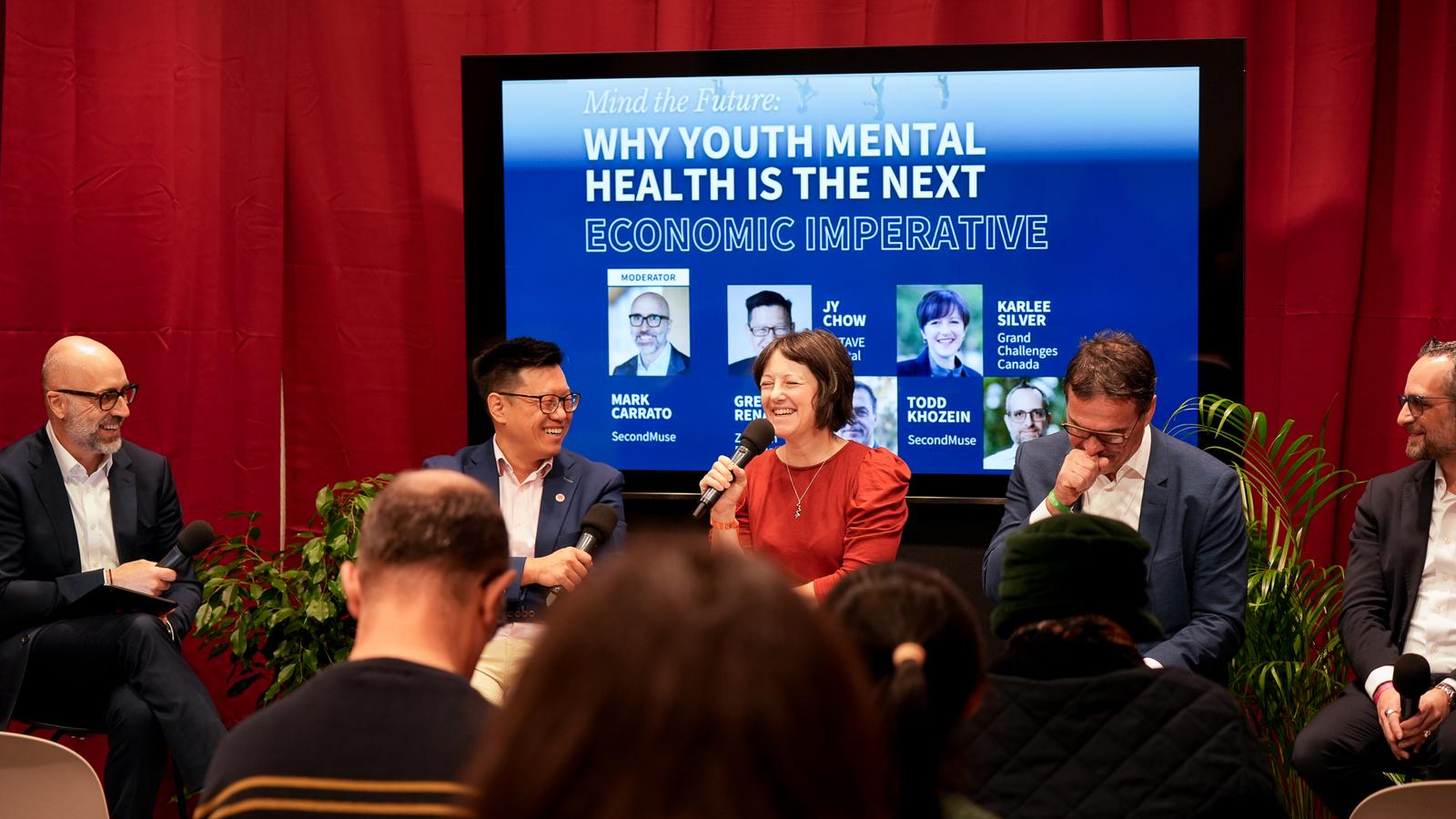
Featuring insights from: Todd Khozein, CEO of SecondMuse; Gregory Renand, Head of Z Zurich Foundation; JY Chow, Managing Director, OCTAVE Capital; Dr. Karlee Silver, CEO, Grand Challenges, Canada
41% of the global population is under 24. This should represent humanity’s greatest economic asset, a generation of future founders, CEOs, and civic leaders poised to drive innovation and growth. Instead, we are witnessing what panelists at our recent World Economic Forum (WEF) convening in Davos this January called a “human mind in recession.”
The numbers tell a stark story. Mental health represents 15% of the global disease burden but receives only 2% of health funding. This isn’t just a moral failing; it’s an economic emergency. Left unaddressed, youth mental health challenges will cost the global economy an estimated $5 trillion in healthcare expenditures and lost productivity. More urgently, these challenges threaten to sideline an entire generation at precisely the moment we need resilient minds most. We’re navigating technological change, moving faster than ever before—it took 50 years for electricity to reach 75% of the US population; ChatGPT reached 100 million users in two months.
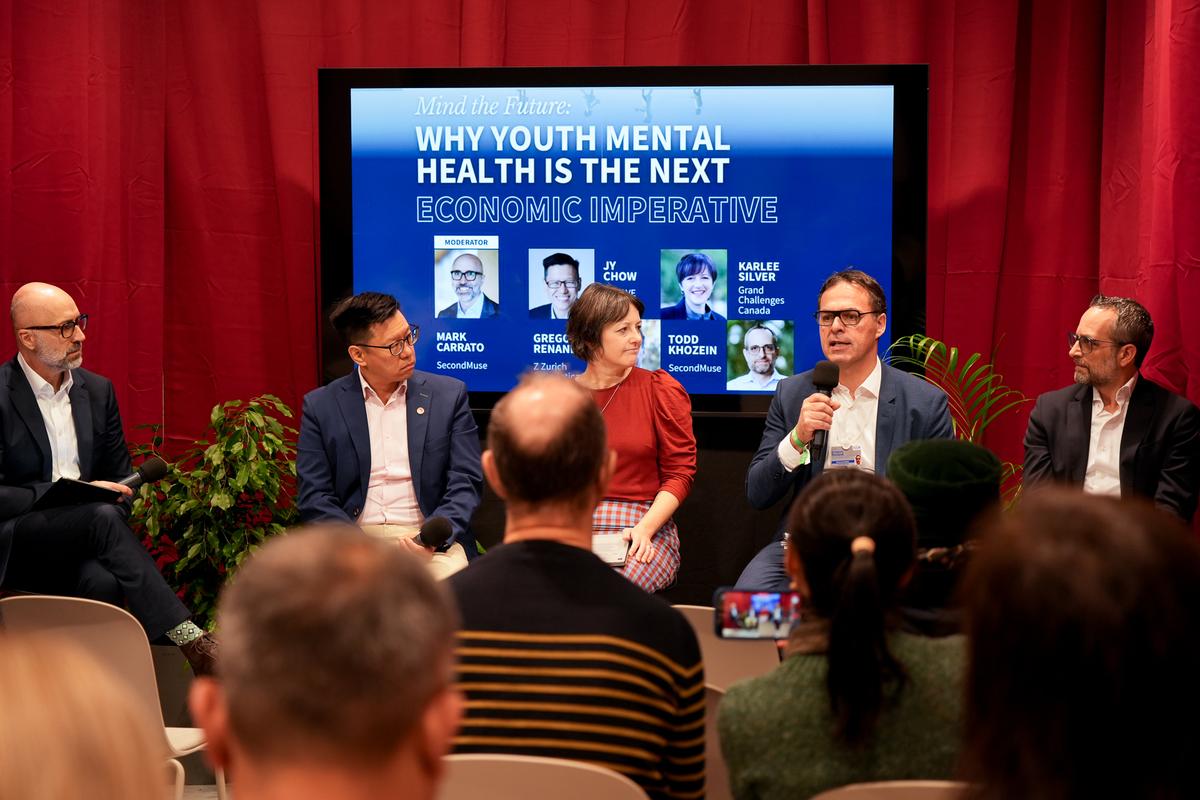
Yet at the TPC House in Davos, leaders from SecondMuse, OCTAVE Capital, Grand Challenges Canada, and Z Zurich Foundation articulated a different narrative. Gregory Renand of Z Zurich Foundation, the charitable foundation, captured the momentum: “When we look at mental health, clearly we see positive momentum on how it is increasingly considered by governments, philanthropists, and private investors.”
The real question isn’t whether solutions exist—they do. It’s why proven interventions can’t scale. The answer represents a fundamental shift: we’re moving from a scarcity mindset to an investment mindset. Through initiatives like the Brain Health Action Forum and the McKinsey Brain Economy Project, the WEF is repositioning youth mental well-being as “brain capital,” essential economic infrastructure that determines workforce productivity and innovation potential. What’s missing is the market infrastructure to deliver solutions at a population scale.
Prevention as Protection
The youth mental health sector has operated under a backward funding model, with resources flowing overwhelmingly toward treatment rather than prevention. Gregory Renand brought an insurance industry perspective: “Prevention is the best form of protection.”
In the European Union alone, mental health costs represent 4% of GDP annually, yet this crisis is largely preventable. When young people develop emotional regulation skills alongside technical capabilities, their ability to integrate into the workforce is transformed. The brain capital perspective shifts mental health from a cost center to infrastructure investment.
From an investor’s perspective, prevention delivers better outcomes at lower cost with longer-term impact. Dr. Karlee Silver of Grand Challenges Canada, a non-profit innovation platform and impact-first investor, added, “We need to build these skills. We need to help youth develop healthy practices before they start seeing these real rises in chronic and serious mental illness. And so that means you need to get there before (age) 24.” The challenge is supporting innovation and building systems that can deliver at scale.
The Scaling Paradox
The bottleneck preventing youth mental health solutions from reaching young people isn’t innovation; it’s infrastructure.
Todd Khozein framed it directly: “Innovations don’t fail because they don’t work. They fail because they can’t be scaled.”
Gregory Renand reinforced this idea: “We don’t need more products. We need effective mechanisms to deliver those products.” The workforce pipelines, payment models, and coordination mechanisms required to translate proof of concept into sustained implementation simply don’t exist in most markets. This is the work SecondMuse specializes in: building the connective tissue that allows markets to function.
JY Chow of OCTAVE Capital, an impact investor, called the “timing fundamental” within the “wellbeing economy”. The conditions are converging: demographic need, economic pressure, and policy recognition are aligning, but building delivery mechanisms takes capital willing to invest in market-building, not just product-building.
Youth-Led and Locally-Led Solutions
Solutions designed with young people outperform solutions designed for them. Dr. Karlee Silver reported that 90% of their Being Initiative portfolio is youth-led and 85% locally led. This isn’t ideology; it’s a practical investment strategy. By investing in solutions devised by those closest to the challenges and providing the right support at the right stage, Silver said that Grand Challenges Canada is helping innovators overcome the commercialization “valley of death” — the critical transition from pilot funding to sustainable operations, where most innovations fail.
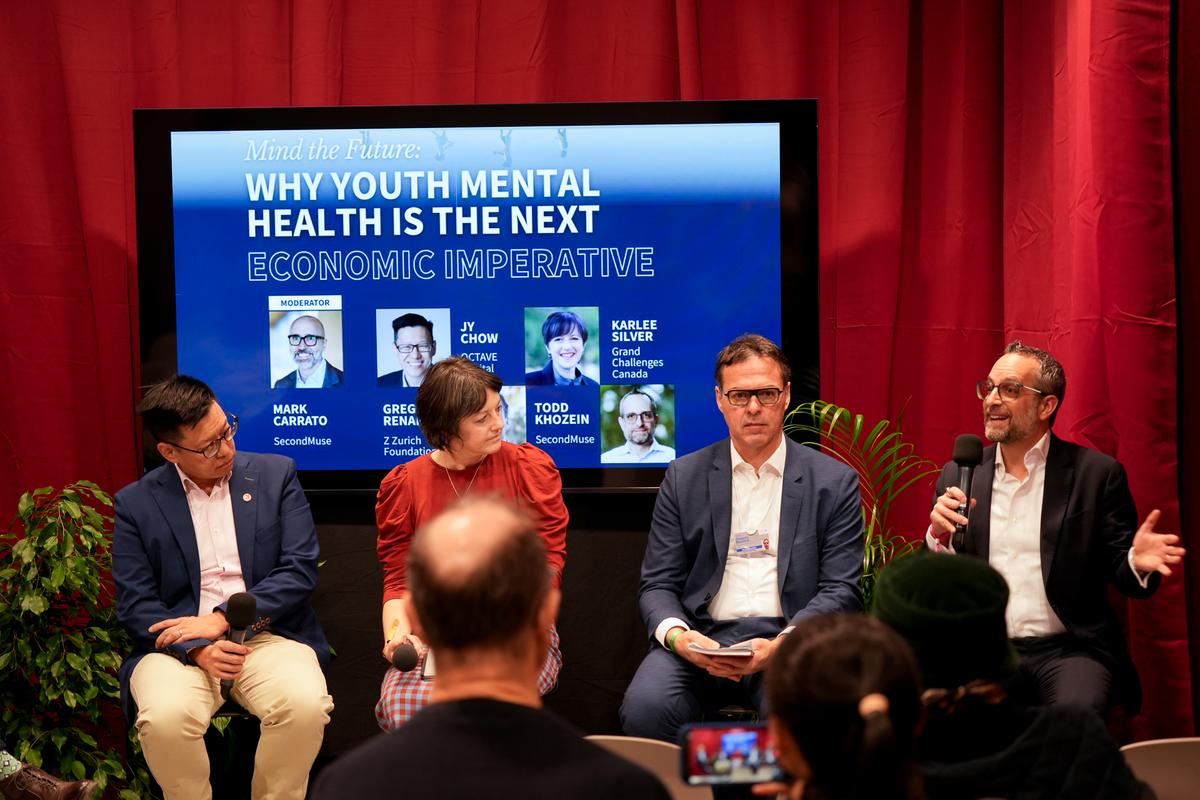
Todd Khozein provided concrete evidence: “When we incorporate youth into the development of the technologies, there’s real market evidence that shows that the products significantly perform better. One of the edtech technologies we had showed 25 times greater retention in students.”
Silver cited a program in Sierra Leone where locally-led mental health interventions produced measurable improvements in school performance and workforce transition, the economic outcomes that matter for long-term investment. Solutions built for the contexts where they’ll be delivered achieve the adoption and sustainability that external interventions cannot.
Financing the Future
Capital struggles to flow into youth mental health because the sector lacks the mechanisms that make markets investable. Dr. Karlee Silver identified the core challenge: it’s not about a lack of supply, but about the need to align and scale innovation that works and to focus on demand. To be truly effective, we need to deploy capital to strengthen systems, not just fund standalone projects.
JY Chow framed the solution: “Success begets success.” Private capital won’t enter at scale until there are demonstrated exits, and as Chow emphasized, successful exits create a virtuous cycle in which “exits lead to more entries” of additional investors. This is where blended capital becomes essential. Philanthropic and catalytic capital must go first, absorbing early-stage risk and building the track record that makes the sector legible to commercial investors.
Todd Khozein offered an analogy: “Home ownership was not a thing for a very long time, and somebody decided to create a mortgage. There’s enough finance there to design unique and powerful financial instruments that center mental well-being but have risk-appropriate returns.” Youth mental health requires similar financial innovation: not single solutions but constellations of investments that support entire ecosystems.
The Economic Imperative
We are at an inflection point. Whether they can navigate it effectively is one of the economic questions of our time.
The infrastructure to support youth mental health at scale doesn’t exist yet, but the conditions to build it are converging. The World Economic Forum’s focus on brain capital as economic infrastructure, the UN Declaration on NCDs and mental health, and growing recognition among investors signal a market moment. What’s required now is radical collaboration across philanthropy, the private sector, and government, speaking the same language about success. Return on investment isn’t just profit; it’s the opportunity to unlock the full potential of the next generation of founders, innovators and civic leaders who will shape our economic future.
Youth mental health is the next economic imperative. The solutions exist. The demand exists. The momentum is building.
What we build next determines whether they meet at scale.
_______
This article is based on the panel “Mind the Future: Why Youth Mental Health Is the Next Economic Imperative” at the TPC House in Davos.
About SecondMuse
SecondMuse is a leading innovation firm dedicated to creating economic value through market-driven solutions that generate lasting impact. We work with clients to fuel sustainable growth while delivering measurable benefits for businesses, communities, and the planet. For over 15 years, we have designed, developed, and implemented innovative programs and financial solutions that unlock new opportunities, expand access to capital, and drive economic transformation. Our work spans 185+ countries and territories.
If you’re interested in exploring how to build the infrastructure that connects youth mental health solutions to the institutions that need them, connect with us here.
About Grand Challenges Canada
Grand Challenges Canada backs Bold Ideas with Big Impact®. As one of the world’s leading impact-first investors and a global innovation platform, we envision a world where innovation helps everyone thrive. We identify, invest in, and help scale solutions that improve lives in underserved communities across low- and middle-income countries and Canada. From seed to scale, we provide flexible support and work alongside innovators to learn, adapt, and grow their impact. Learn more at www.grandchallenges.ca
About OCTAVE Capital
OCTAVE Capital is an impact investment firm redefining capital as a force for good. We invest across private equity and venture capital strategies in business models that deliver commercial performance while driving measurable social and environmental outcomes. Inspired by the structure and harmony of an octave, we bring alignment across people, planet, and capital — investing in systems that matter. As a MAS-licensed firm with deep roots in Asia, we partner with families, entrepreneurs, and future-focused institutions to create enduring value.
Guided by our investment philosophy – capital that connects, impact that transforms – OCTAVE Capital backs innovative companies to become emerging champions and drive inclusive growth that improves the lives of local communities while delivering sustainable returns to investors.
Learn more at www.octavecapital.co or contact us at enquiry@octavecapital.co
About Z Zurich Foundation
The Z Zurich Foundation is a Swiss-based charitable foundation established by members of the Zurich Insurance Group (Zurich). It works alongside Zurich employees and other stakeholders to help communities become more climate-resilient and cope with crises. In parallel, it supports young people to improve their mental wellbeing and access equitable education, employment and entrepreneurship opportunities.
At the Z Zurich Foundation, we believe in a world where young people have the tools and resources to improve their mental well-being. Throughout the 30+ programs we support globally, we aim to create a mental well-being movement that helps young people see their feelings for what they are, so they can prevent stress from developing into anxiety.
According to Prospira Global’s From Momentum to Maturity 2025 report, the Z Zurich Foundation ranks in the annual list of the top reported global philanthropic funders focusing on mental health.
Visit the Z Zurich Foundation’s website to learn more about its work: https://zurich.foundation. Follow the Z Zurich Foundation on LinkedIn, Facebook, Instagram and YouTube or contact us at z.zurich.foundation@zurich.com