
Food System Vision Prize: Building a Resilient Food Future
May 27, 2020
The COVID-19 pandemic has made it clear—many of our current systems, including in the food sector, have not been designed to respond to major crises. However, at this moment, there is an opportunity to think boldly about how we can rebuild our food systems for a more equitable, sustainable, and nourishing future.
About the Food System Vision Prize
The Food System Vision Prize, launched by The Rockefeller Foundation and powered by SecondMuse and OpenIDEO, is an invitation for inspiring, compelling, and actionable visions of regenerative and nourishing food systems in the year 2050. After issuing a call to action for organizations to develop the food systems they aspire to create by 2050, we received over 1,300 submissions from across the globe. In early March, we were thrilled to announce 79 Semi-Finalists to join the Refinement Phase. These Semi-finalists are now working to refine their visions for analysis by judges, who will vote for a ‘Top 10‘. $2M will be distributed among the Top Visionaries, who will each be eligible to receive a prize of $200,000.
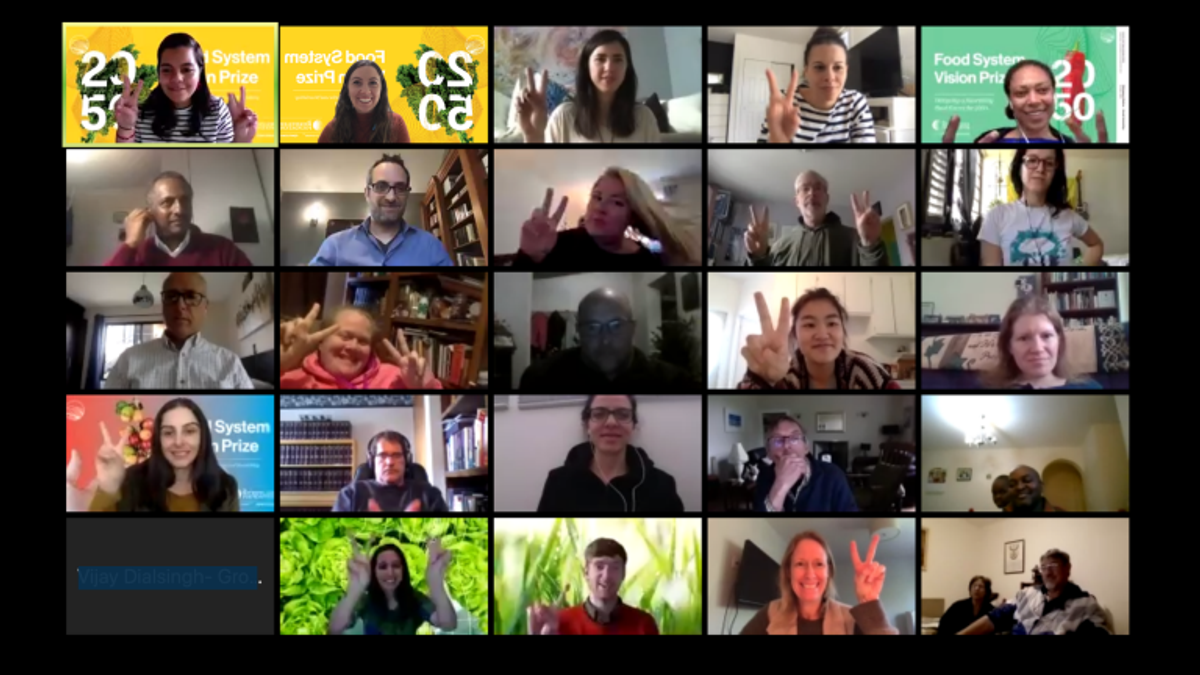
On May 12, we hosted a virtual expert panel for our semi-finalists to help them leverage systems thinking and resilience as design principles as they finalized their submissions. SecondMuse Co-CEO Todd Khozein was joined by Million Belay, Coordinator of the Alliance for Food Sovereignty in Africa, and Emma Chow, Food Initiative Lead at the Ellen MacArthur Foundation, to explore and unpack our common goal of truly resilient food systems. Centered on macro-level lessons they’re seeing, the key points below are an invaluable resource for any organization seeking to improve global food systems.
What resilience means for food systems
SecondMuse Co-CEO Todd Khozein outlined the components of what resilience means in the context of food systems:
- Moment of Reckoning: COVID-19 is forcing us to rethink our food system, surfacing the all-important question of what we want to rebuild. The current system is designed for speed and accuracy and was not prepared for this crisis.
- Localization: So much of the food we take for granted comes from faraway places, arriving on our tables through long, vulnerable supply chains. More localized supply chains mean greater confidence in food quality and safety while reducing environmental impact and the risk of disruption.
- Inclusion: We need to ask who is participating in this economy. Those invested in it will share in the response. To build a truly resilient system, we need to transcend our individual silos and vantage points so the system can operate as a whole.
- Redundancy: Every critical system has a second system in place, ready to take over if the first one fails. We can’t rely on a single supply chain with its single points of failure.
Designing food systems that adapt to climate change
Emma Chow from the MacArthur Foundation walked participants through how the food systems of 2050 must adapt to climate change and remain resilient, and how the circular economy can help create food systems that allow people and nature to thrive. In order to design food systems that are resilient to the increasingly frequent weather shocks resulting from climate change, we must:
- Build Healthy Soil: Healthy soil is critical to withstand the shocks of floods and droughts. But each year, an area of soil the size of England is degraded to the point that we can no longer cultivate food. In particular, about 40% of the world’s cropland is in the 20-kilometer orbit of cities - if we restore and maintain these soils, they can effectively support cities and their citizens.
- Boost Biodiversity: Historically, humans have consumed more than 7,000 agricultural species. But today, just 3 crops provide over 50% of the world’s calories. Creating resilient systems means growing a greater diversity of crops.
- “Design Out” Waste: Dependence on finite resources and massive food waste are major contributors to climate change. What if we were able to design a system using nature’s principles to produce no waste? We need to take what is available to us - what is often seen and treated as “waste” - as a resource to help us in the future.
How culture sustains biodiversity
Million Bellay spoke to the importance of ensuring that cultural, spiritual, and community traditions flourish in the food systems of 2050. There are four bridges between preserving culture and boosting biodiversity:
- Spirituality: Different cultures hold distinct views on nature, available resources, and taboos rooted in spiritual beliefs and worldviews. These all impact how they produce and interact with food.
- Livelihoods: As a set of practices or ways of doing things, culture shapes biodiversity through the direct selection of plants and animals for livelihoods and thus the reworking of whole landscapes.
- Language and Knowledge: Language is how we contextualize our understanding of natural resources and biodiversity - how we know and understand the world governs our behaviors relating to it.
- Norms and Institutions: Culturally ingrained ethics determine how we govern ourselves, who owns the land, and who is responsible for every step of the food supply chain.
Looking ahead
The challenges can seem ominous: a global population approaching 10 billion, greenhouse gases changing our climate, and pollution poisoning our soil, air, and water. Yet there are opportunities to address these challenges if we act together to transform our food systems. We’re optimistic about the future with initiatives like the Food System Vision Prize bringing people together for visionary work—and this is just the beginning.