When the Whole Economy Shows Up: Eight Years of Building for Youth Mental Health
July 21, 2026
By David Ball, Head of Well-Being, SecondMuse
Sometimes you need a little luck. I'll never forget a conversation I had in 2021, three years after launching Headstream, with a group of technology and youth mental health leaders who had spent decades of their careers advocating for digital well-being. The slightest hint of envy permeated our conversation about the exploding demand and need for digital mental health and well-being solutions brought on by COVID-19. After years of advocacy, awareness-building, and destigmatization work, the pandemic seemingly brought our work to the forefront overnight. Headstream, a program launched by SecondMuse to address youth mental health and well-being, was in the right place at the right time.
In the months and years that followed those early-pandemic shifts, venture funding for digital health startups focused on youth mental health exploded, reaching a record 691 million in 2020. Within that, funding for youth mental health startups grew 7.5x in the first half of 2021 compared to the same period a year earlier, and deal activity increased by 79%. Healthcare and education systems scrambled to find digital interventions to support virtual and remote treatment amid growing demand, a struggling workforce, and the countless other variables that COVID-19 introduced. There was unprecedented alignment and resourcing for the sector that even extended across the political aisle to policymakers at the state and federal levels.
Resources for emerging sectors inevitably fluctuate. These moments of cultural and market transformation may only happen once in a career. Taking a whole-economy approach that builds the systems architecture to sustain a sector over the long-term often takes a back seat when markets are booming. That critical coordination and connective infrastructure that no single player owns is easy to deprioritize when the focus is on capturing near-term growth. We launched Headstream with a clear-eyed bet to establish a foundation for the future, focused on innovation and coordination across the entire economy to maximize impact on young people’s mental health and well-being.
What has followed is a model that has proved itself over time. Through the innovations we have co-created, invested in, and accelerated, as well as the partnerships with health and education systems, Headstream has supported the mental health and well-being of over 51 million people. These lessons apply beyond Headstream.
The bet was on coordination in concert with innovation
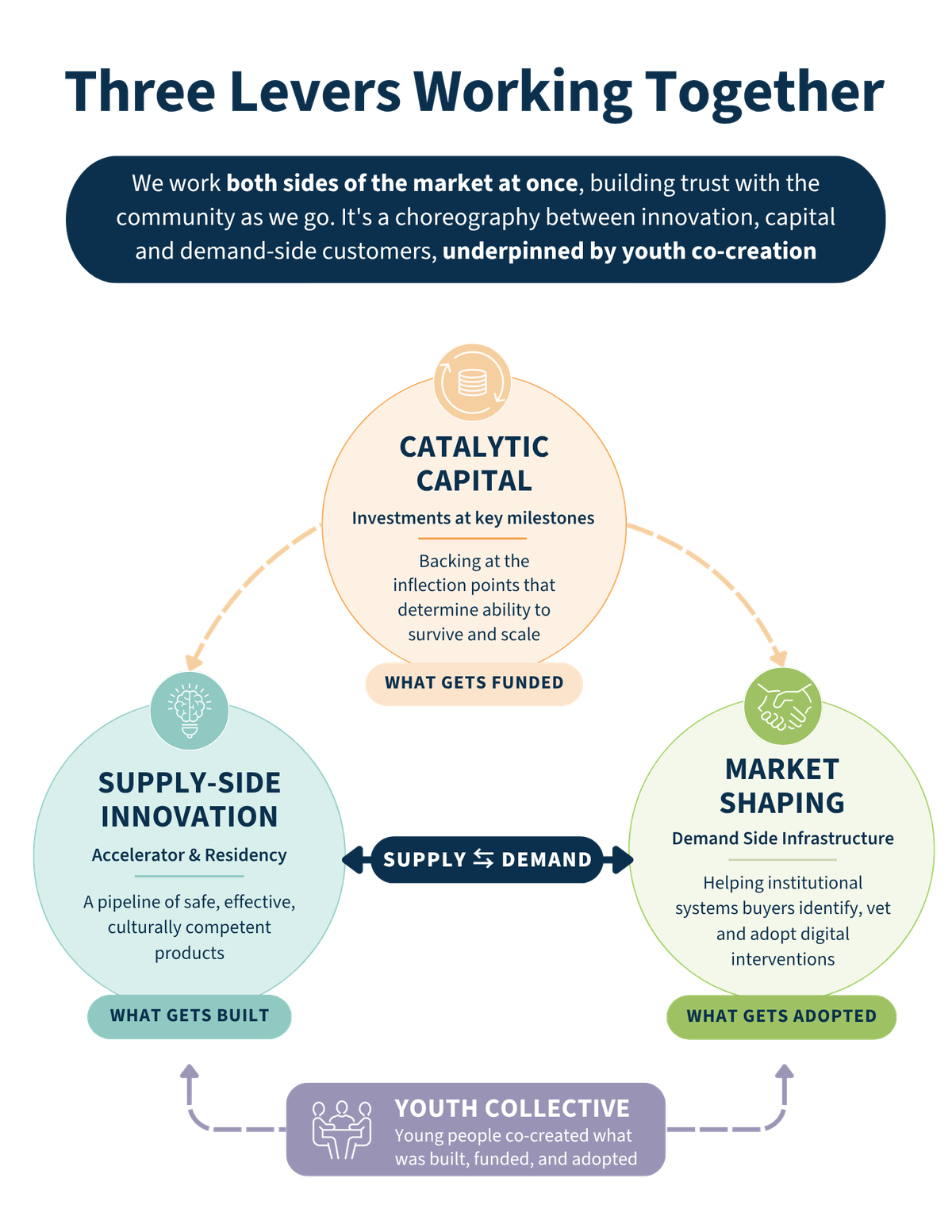
That 2021 conversation stuck with me for another reason: luck only pays off if the pieces are already in place to capitalize on it. Headstream was designed around three levers – supply-side innovation through our Accelerator and Residency programs, market support infrastructure for demand-side customers in the health and education systems, and deployment of non-dilutive catalytic capital into startups at critical inflection points. Integrated into all three levers was the Headstream Youth Collective, ensuring that young people shaped what was built, funded, and adopted.
“Headstream arrived at a time when the market for youth mental health interventions was transforming overnight,” shared Solome Tibebu, Founder of Behavioral Health Tech. “They had the foresight to design for what inevitably came after the initial boom.”
The premise was straightforward. New markets don't build themselves. Institutional buyers, in this case, health and education systems, struggled to adopt safe, effective, and culturally competent products to support the well-being of their students and patients in an increasingly crowded market. Supply without dependable, navigable demand won't scale even with a funding boom. We saw an opportunity to work both sides simultaneously. And to build trust with the communities being designed for, before expecting them to show up.
What the architecture led to
Each lever of Headstream's model has a collection of stories behind it, a specific company, school district, or young person whose trajectory changed because the infrastructure existed across an entire system.
Hafeezah Muhammad, a founder in Headstream’s second Accelerator cohort, built Backpack Healthcare to close a specific gap. Only 14% of mental health clinicians in the U.S. accept Medicaid, even though more than 40 million children rely on it for coverage. Through Headstream, she was able to get the funding she needed at the moment it mattered most. As Hafeezah described it, "We were about to go to zero at one point, and then Headstream had a program that provided catalytic capital. Around the same time, Hopelab also invested in us. Together, that support gave us the opportunity to keep building when it mattered most.” Since that early catalytic investment, Backpack has raised more than $20 million, expanded into five states, and served more than 5,000 children, young adults, and families. “Backpack is an example of the ripple effect of investing in founders who solve hard problems for communities that are too often overlooked."
The calculus of a risky investment is often based on antiquated rationale grounded in historical and cultural factors. Market opportunities exist for investors. Take, for example, the outsized returns that investments in women-founded companies, such as Backpack Healthcare, are leading to for targeted funds. “The leaders and models with the most potential to change outcomes for young people are frequently the ones that don't fit traditional funding structures and growth trajectories,” shared Nathaan Demers, who has sat on both sides of the table, currently as Principal Investor at Hopelab and formerly as a Headstream Accelerator participant with Grit Digital Health. “If we only back what already looks safe, we tend to overlook innovations that can deliver the most impact. Headstream understands that making a deliberate bet on the right founder at key inflection points isn't a gamble; it's how you build momentum for system change in support of the health and well-being of underserved populations.”
Capital at a critical moment in the startup journey solves one challenge for early-stage startups. Customer acquisition is another. The most promising digital mental health startups were struggling to expand beyond their initial customer base. The State by State: Youth Mental Health Data tool was created to accelerate founders through the process of expansion. In-depth data on state-level regulation, funding, and Medicaid coverage have helped Headstream’s portfolio prioritize which states to focus on as they expand markets.
Somethings, a Brooklyn-based peer mental health platform that came through Headstream as a Residency company, is a case study in identifying market fit beyond its initial geography. In the aftermath of Hurricane Helene, Somethings was deployed across North Carolina, freely available to all teens during the critical outside-of-school hours. That expansion got the startup past a major hurdle. The company recently closed a $19.2 million Series A and now supports more than 11,000 teens across 200+ schools and 250 community organizations, reporting a 65% reduction in depression and a 60% reduction in suicidal ideation among participants. "Because of Headstream, I was able to connect with other founders and get connected to a strong network of potential partners and customers," shared Founder and CEO Patrick Gilligan.
Our whole-economy approach at Headstream wasn’t limited to the obstacles startups faced. The next challenge showed up on the buyer's side. How do school district leaders evaluate a crowded field of digital health tools well enough to choose one that meets their students' needs? The K-12 Mental Health Tech Navigator, developed with The Jed Foundation and the Meadows Mental Health Policy Institute, exists to answer that question. Twelve education leaders convened to build the original roadmap, and in 2025, Headstream partnered with 15 school districts and state education leaders to improve the platform.
To date, over 11,000 users have accessed the Navigator, and districts have used it to identify, evaluate, and pilot new interventions. In Southwest Florida, one district evaluated over 100 potential products, ultimately selecting Clayful, a Headstream Residency company that provides on-demand coaching for students and school staff. The perfect convergence of Headstream’s supply and demand-side levers.
A key but often missing component
When Headstream launched, institutional skepticism about utilizing digital interventions to address mental health challenges was high. The notion that young people should co-design what their care would look and feel like was met with skepticism. Today, digital mental health tools are seen not as alternatives to care but as critical supplemental support that increases access to quality care when there aren’t enough human resources to meet demand. Uptake and adherence are being prioritized alongside access. And lived experience, from both founders and the young people who are the ultimate beneficiaries, has become a signal of quality, not a footnote.
Headstream has modeled co-creation with young people through the Youth Collective. 140 teens have served as co-creators, working directly with startups and other ecosystem partners. The youth-adult collaboration goes beyond focus groups, structured as active partnerships over multiple months that shape product development, policy, and investments. We called this youth co-creation, and it wasn't a feature we added. It was critical infrastructure.
"Not only is [youth co-creation] something that can add to the experience, but it's central to the development of our company and our product," said Psyche Care Co-Founder and CEO, Mallika Pajjurif. "It was through [youth] voices that we were awoken to this fact and have brought that into the core of our development to date. It's just completely shifted the way that we've approached building Psyche from that day forward."
The Youth Collective is also a critical investment in future leaders. 2024 co-creator, Ashmita Annamalai, shared, “I truly got to see how valuable youth experience and voice are, because oftentimes it's something that's just said, but never actually done. I loved seeing the extent of our power to make change for the better. I also learned from so many new perspectives on innovation.”
None of this works, though, without the people the whole system is meant to serve. When New Mexico's Department of Health (NMDOH) launched its Youth-Adult Partnership Committee, Headstream supported the design and facilitation of the inaugural Youth Empowerment Action Summit. In collaboration with Headstream alumna Katherine Grill, we developed co-creation sessions in which youth facilitators led breakout groups with participants from across the state to inform future health policy in New Mexico.
The difference between performative youth involvement and authentic co-creation, in which young people are positioned as leaders and decision-makers, is monumental. As is the impact. Products and policies built with young people are better positioned to earn their trust. Neolth, Katherine Grill’s company, achieved 25x greater retention and 31% higher satisfaction than industry standards. Across Headstream’s portfolio, the companies that invest in youth co-creation outperform their peers in adoption, engagement, and retention of their young users.
The architecture produces results
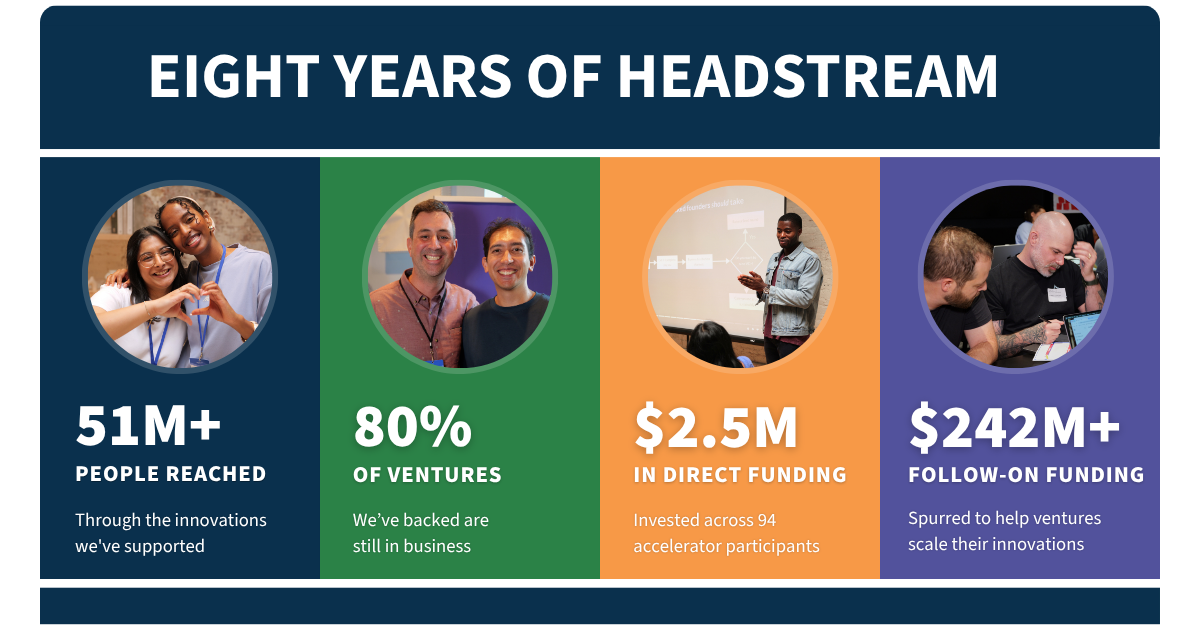
Combined, through the levers Headstream has pulled across the youth mental health sector, more than 51 million teens, students, and the caring adults in their lives have been supported through the interventions Headstream has accelerated. 80% of the ventures we've backed remain in business, a stark contrast to the U.S. economy overall, where Bureau of Labor Statistics data shows roughly 50% fail within five years, across all sectors. Over the last eight years, Headstream has invested $2.5 million in funding to 94 startups to seed early-stage innovation from innovators who might not traditionally be funded and to help scale startups that have demonstrated impact serving underserved communities. Those investments have helped spur over $242 million in follow-on funding.
What this tells us about the path forward
Economies evolve over time. Innovation, culture, and global events influence the levers of a market. Some of these shifts may be predictable – the rapid adoption of social technologies, for example; others, like pandemics, less so. Interventions, such as Headstream, also influence economies, especially at moments of transformation. We are living through one of those moments. Eight years ago, stigma around mental health prevented it from being discussed in dining rooms across the country. Now it is part of a national dialogue and a bipartisan focal point. Eight years ago, most people’s familiarity with AI came from sci-fi pop culture. Now, the technology is making us question the future of health, education, and work. These shifts or leaps necessitate that we evolve our approach as well.
The youth mental health ecosystem is more mature, trusted, youth-informed, and culturally competent than it was eight years ago. Headstream has played a role in that. The levers we pulled shifted when COVID-19 hit, when the digital health investment bubble popped, and when national and state policies started to prioritize mental health. In the next article in this series, we will dive deep into how Headstream plans to evolve to meet the mental health and well-being needs of young people in the second half of this decade. If you are interested in collaborating on shaping this future economy, connect with me at david.ball@secondmuse.com.